
BTRTN: Our Annual Analytically-Based Major League Baseball Hall of Fame Predictions
We continue our brief detour from politics for our annual prediction of who will be elected to the MLB Hall of Fame in the BBWAA balloting, which is now underway -- a Ruthian task, indeed.

It’s that time of year again…the votes have begun to be tabulated for the Baseball Writers Association of America (BBWAA) Hall of Fame (HOF) ballot. The reults will be announced on January 20, 2026.
Last week the Contemporary Era Committee had the excellent sense to agree with our judgment (offered in this space last week) that Jeff Kent was the only Hall-worthy candidate on their ballot. We have our doubts that the BBWAA will do the same.
Each year we at BTRTN analyze the ballot – in-depth, analytically -- to answer two questions:
1) Which nominees do we predict will be elected in this year’s voting, receiving at least 75% of the vote of the BBWAA?
2) Which nominees deserve to be in the HOF?
The two lists are never identical.
For the first question – our prediction of who will be elected -- we use various statistical models (based on the candidates’ stats and, for those returning to the ballot, how they’ve done in prior years on the ballot) and add in a dose of judgment to come up with an estimate of the percentage of the vote they will receive. Anyone reaching the 75% threshold is predicted to be enshrined.
For the second question – who on the ballot deserves to be in the HOF -- we have developed a methodology to compare nominees to their same-position predecessors to determine their “Hall Worthy-ness.”
A few notes before we get to our answers. First, we do not look at the service that compiles the public ballots of BBWAA as they announce them (some writers make their ballot public, some don’t). It is not very helpful in making predictions even as the actual tallies rise, because the writers who reveal their votes publicly tend to differ quite a bit from their more private counterparts, especially on the more controversial candidates. So one can easily be misled by the public tally, because it is not a statistical sample of the entire BBWAA voting universe. (But we don’t look at it anyway, because that would spoil the fun of a totally blind prediction!)
Finally, it would be wonderful to report that the steroid era is over, but unfortunately that is not the case. Four players on the 2026 ballot are tainted by usage of performance enhancing drugs (PEDs): returnees Andy Pettitte, Manny Ramirez and Alex Rodriquez and first-timer Ryan Braun. Our custom is to not consider the Hall-worthiness of the PEDsters, for reasons we have enumerated many times.
(Quick recap: we believe they violated a clear rule of the game, Fay Vincent’s 1991 declaration that the possession, sale, or use of steroids was strictly prohibited. Violations of that policy materially affected the outcomes of games and artificially inflated the users’ statistics, at the expense of their peers who were not users, players like Derek Jeter, Cal Ripken, Jr., Frank Thomas, etc. We have heard every counterargument under the sun, including those who cite baseball’s non-enforcement of the prohibition until 2005; note that the HOF is full of sinners; and that other potential users did not get caught and ended up in the HOF; and so on. We are not moved by these arguments. Our view is that the PED players are, ipso facto, unworthy of enshirenement. They cheated the game, but have been allowed to keep their rings, their awards, their statistics and the millions of dollars they made. Let’s deny them the one honor left for them: Cooperstown.)
Other players on the ballot are, shall we say, problematic as well. Carlos Beltran was embroiled in the Houston Astros cheating scandal, and Omar Vizquel has been accused of various forms of abuse. I discuss both of those candidates in their player write-ups below.
HOW DID WE DO LAST YEAR?
We rather immodestly bill ourselves as “The Best MLB Hall of Fame Predictors.” That may be accurate since, as far as we know, we are the only HOF predictors left since Bill Deane gave it up a few years ago after making predictions for nearly four decades. (Bill did so poorly in his predictions one year that he gave it up.) We’d welcome some competition! Last year was one of our worst years, the worst since 2018.
We accurately predicted that Ichiro Suzuki would be elected to the Hall of Fame (aren’t we good!) and we also (accurately) did not think he would make it as a unanimous pick (he missed by a single vote). Of course, he and many others should have been unanimous picks. I’ve never quite understood the logic of a player’s chances “improving with time” — isn’t a player worthy, or not? Something I think we’d do better with a two-year period, which gives a voter one chance to see the error of their initial judgment, if they are so inclined.
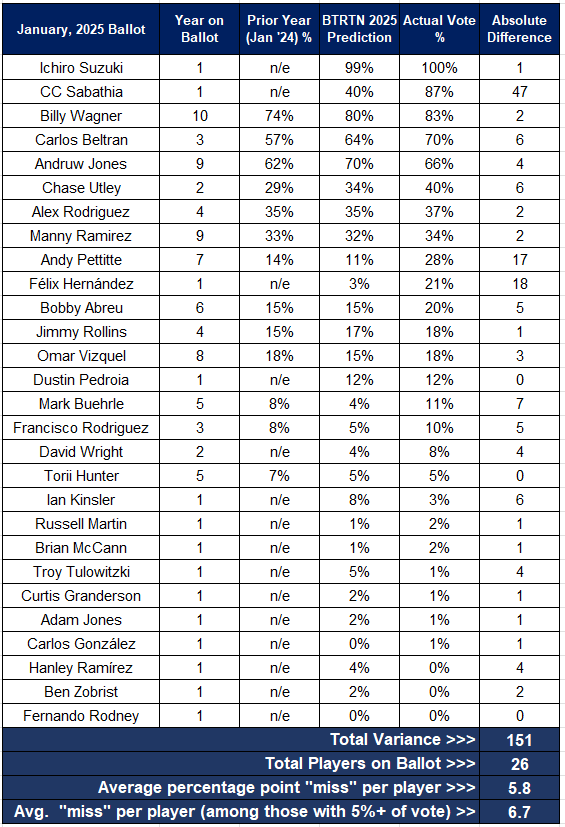
The hardest thing to predict is the number of votes a viable first-time candidate will get, and here we ran into our only major problem – we dramatically missed on C.C. Sabathia, who made with Hall of Fame with 87% of the vote, far higher than the 40% that we predicted. We also underestimated the support for first-timer Felix Hernandez (21% versus our prediction of 3%) but managed to nail Dustin Pedroia (a spot-on 12%).
We did better with the admittedly easier task of predicting the returnees, helped by their track record, though we were surprised by Andy Pettitte’s sudden surge from 14% in 2024 to 28% in 2025.
You can see how we did for each player on the January 2025 ballot on this chart.
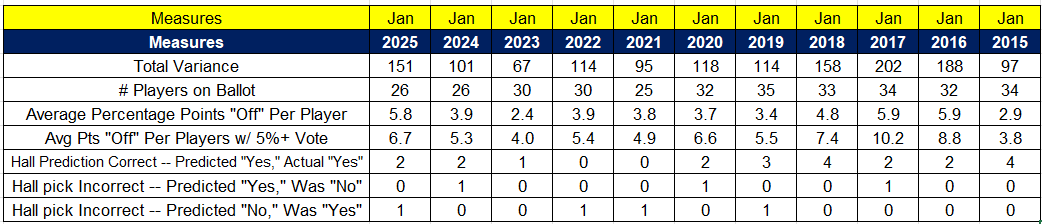
Here is our track record that illustrates what a bad year we had. Perhaps the most important measure is the fourth line down, how far off we were among those who ended up with 5% of the vote or more. Recently we have only been off by 4-5 percentage points, but thanks to Sabathia, Hernandez and Pettitte we soared to 6.7, our worst showing since 2018.
WHO WILL BE ELECTED? THIS YEAR’S PREDICTIONS
The chart below shows the complete voting history (in percentages) of all 15 returning players.
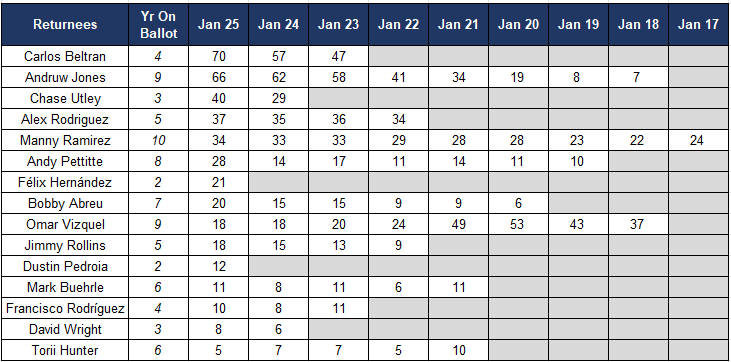
You can see which way the wind is blowing for the returnees easily enough:
The top three 2025 finishers (among the returnees), Carlos Beltran, Andruw Jones and Chase Utley are all on the rise.
Three of the troubled vets, Alex Rodriguez (PEDs), Manny Ramirez (PEDs) and Omar Vizquel (various abuse charges) are all stalled out. But not Andy Pettitte — you can see why I was surprised by his 2025 jump after six more or less flat years.
Jimmy Rollins and Bobbie Abreu had some upward movement but are still at low levels. Abreu is running out of time to make sharp upward movement.
We’ll see if Felix Hernandez and Dustin Pedroia can build on their double-digit first ballot support.
Mark Buerhle, Frankie Rodriguez and David Wright all have a chance to build on some modest progress to stave off potential elimination, but Torii Hunter may be on his last ballot.
A batch of newcomers have been added to the ballot, of course, but none of them are particularly exciting. The class is led, such as it is, by Ryan Braun (who is PED-tainted) and Cole Hamels, and neither, in our view, are true first-ballot contenders.
The most important thing about the first-timers is that because of their thin quality, it should be a very good year for the returnees. Voters tend to look elsewhere when there are no obvious first-ballot candidates, and that often leads to decent bumps for many of the returnees, especially those who are knocking on the door.
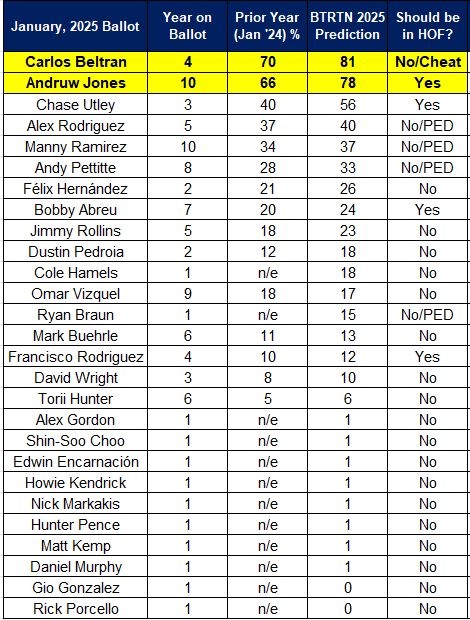
Which brings us to our most important prediction: BTRTN predicts that the BBWAA will elect Carlos Beltran and Andrew Jones to the MLB Hall of Fame.
Here’s the summary chart of this year’s ballot, which has 27 players on it, 15 returnees and 12 new. The chart includes our official BTRTN 2026 Hall of Fame predictions (expressed in the 4th column as a percentage of the total vote), and also which candidates belong in the HOF (the last column). To read our views on all the candidates, after the chart we move on to the next question – who on this ballot deserves to be in the Hall of Fame?
WHO DESERVES TO BE IN THE HALL OF FAME?
The second question we ask annually is this: putting aside what the writers think, who on the ballot do we think is “HOF-worthy”? Drum roll, please: this year we find only four players who, in our view, deserve to make the grade: Andrew Jones, Chase Utley, Bobby Abreu and Frankie Rodriguez. Not a great year!
To arrive at our conclusions, we use the following analytic methodology. We compare each player to Hall of Famers and “just misses” (among those whose careers started after 1950) at his position across a number of key statistics, both traditional (hits, homers, RBI’s and batting average) and non-traditional (OPS+ and WAR). To get a sense of how they were valued “in their time” we also look at their number of All Star selections and times appearing in the Top 10 in the MVP balloting (for pitchers, we use an identical methodology but, of course, with various pitcher stats instead, a set for starting pitchers and a somewhat different set for relief pitchers.)
We show the average statistics by position. So we compare, say, David Wright to third baseman and Bobby Abreu to outfielders. Within each position, we compare the nominee, sticking with Wright in this example, to third basemen who are in these four groups:
The “top half” of all post-1950 HOF third basemen, using a ranking based on WAR. (This group, for third baseman, includes Mike Schmidt, Eddie Mathews, Adrian Beltre, Wade Boggs and George Brett)
The “average” of all post-1950 HOF third basemen (all those plus the list below)
The “lower half” all post-1950 HOF third basemen (Chipper Jones, Brooks Robinson, Scott Rolen and Ron Santo)
The “next ten,” the ten post-1950 third basemen who have the highest WARs among those who are not in the HOF (Graig Nettles, Buddy Bell, Sal Bando, Ken Boyer, Darrell Evans, Robin Ventura, Ron Cey, Toby Harrah, Matt Williams and Carney Lansford).
The last two groups define the so-called “borderline” candidates. Our general feeling is that to be worthy of the HOF, a candidate should be at least as good and probably materially better, on balance, than the last two groups. Thus, they have to be better than borderline candidates, most of whom are either not in the HOF (the “next ten”) or include at least a few players (though not in the third base group) who should never have been enshrined in the first place, and reside in the “lower half.” (We are not rigid, and you will see, we make exceptions.) We also take into account a player’s postseason performance.
Why do we only compare players to post-1950 players? All statistics have a certain amount of noise, of course, but particularly so for baseball statistics before 1950. Among the major happenings that cause statistics to be less comparable than more recent decades, before 1950 baseball was (mostly) not integrated (we do not include the Negro League stats at this point, which would help a bit, but they are quite incomplete); all the teams were east of the Mississippi; there was the dead-ball era pre-1920; the wildly batting-inflated 1930s and the talent drain of the two World Wars. While we believe we have a solid base of players from the last 75 years to draw from, we occasionally include a few players whose careers started in the 1940’s just to make sure we have a “large enough” comparison group in every given position.
Again, we do not include the PED players in this analysis. Since the use of PEDs obviously influenced their stats, we try to keep the analysis PED-free. (We do touch on Ryan Braun briefly.)
On to the analysis!
Catcher
There is not a single catcher on the ballot this year. Buster Posey will be on next year.
First Base
And, not a single first basemen on the ballot either! Albert Pujols comes on in 2028.
Second Base
Chase Utley and Dustin Pedroia are returning to the ballot and they are joined by Howie Kendrick and Daniel Murphy.
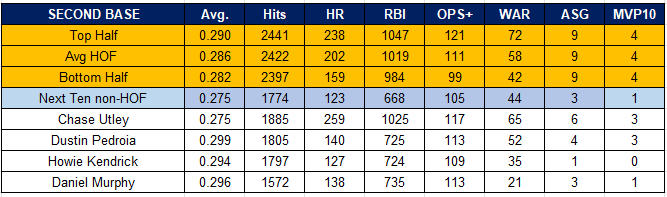
Chase Utley was a power hitting second baseman, and, as the stats show, he is right up there with the greatest second basemen, the top tier HOF’ers at the position. Despite a somewhat shorter career than the greats (thus the lower hit total), he is up there with them in homers, RBI, OPS+ and WAR, and above the HOF averages on all of them. His excellent WAR also reflects the fact that he was a terrific fielder. With six all-star selections, three Top 10 MVPs and 10 postseason homers, I give Utley a thumbs up.
Dustin Pedroia is a very tough call, and last year my Red Sox friends gave me a very hard time about my thumbs down, so I stared at his candidacy again just to be sure. Injuries cut short Pedroia’s career effectively at age 33 (he made two comebacks after that that failed), so he did not have chance to compile the stats, nor was he sublime enough to warrant admission on the basis of the 11 full seasons he put in a the Sox sparkplug (to do that, you have to be more like Sandy Koufax or Ralph Kiner). He was certainly an excellent player and even won an MVP in 2008. But his stats hang more with the “next-10” grouping, the borderline second basemen. For good measure, I checked his postseason stats, and while he was a post-season perennial with great Red Sox teams, he was quite lousy on the big stage, managing only a .687 OPS across 51 games and 234 plate appearances. So, again, with apologies to my Sox friends (and noting that I said “no” on my own Don Mattingly last week), I again come to the conclusion that it’s a thumbs down for Pedroia.
No one could possibly think that either Howie Kendrick or Daniel Murphy are Hall of Famers, but it is interesting that both of them have similar “accumulation” stats as Pedroia, and similar batting averages and OPS+ as well. What clearly separates them from him is the WAR, which reflects that Pedroia was an excellent fielder, while Kendrick was average and Murphy was terrible. It’s worth noting that many will remember Murphy solely for his timely hitting explosion in the 2015 postseason, when he hit seven homers in the NLDS and NLCS (though he was a bust in the World Series that year). But such heroics, while memorable, do not automatically land one in the HOF (just ask Dusty Rhodes or Gene Tenace). So, thumbs down for Kendrick and Murphy as well.
Shortstop
We have two returnees at shortstop, Jimmy Rollins and Omar Vizquel.
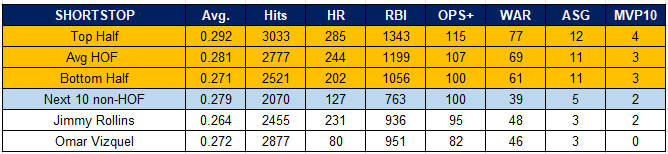
Jimmy Rollins was Utley’s keystone partner for many years, but he is not in the same conversation as Utley in terms of the Hall of Fame. His stats fall in a weird zone, better by and large than those of the non-HOF borderline group, but generally below the lower-half HOF group, particularly his OPS+ (which is below the league average for his career) and his WAR. He only managed three All Star selections, though he did win an MVP in 2007. His postseason stats are quite similar to Pedroia’s: 50 games, 215 plate appearances and .673 OPS. The view here is thumbs down on Jimmy.
Omar Vizquel did well in the balloting in his first three years, establishing a voting track record (37%/43%/53%) that seemed well on the way to enshrinement. But after a series of abuse charge (separate incidents involving sexual harassment and domestic violence), Vizquel plummeted in 2022 (24%) and dropped even more the last two years (20% and 18%). It seems unlikely that he will be able to recover in his remaining two years on the ballot. But, regardless, we never considered Vizquel to be HOF-worthy. The only offensive stat he really has going for him, in comparison to the peers, are his 2,877 hits (which he compiled over 24 seasons). But there is no getting around his OPS+ of only 82, which settles the matter on the offensive side. He was an excellent defender, with 11 Gold Gloves, and 129 “runs saved” in his career. But he was no Ozzie Smith or Mark Belanger, who had 239 and 241, respectively (or even a Craig Counsell, who had 127), and his defense could not pull his WAR to HOF standards, not even close. He made only three All-Star teams in those 24 years and was never a Top Ten finisher in the MVP balloting, so, horrific behavior aside, we’ve always had him as a thumbs down.
Third Base
David Wright is back and is the only third-sacker on the ballot this year.

David Wright is another player in the Don Mattingly mold, having had a sustained burst of excellence to start his career, but thereafter was diminished by injuries. His last good season was at age 30 and he was done at 33 (save for a few games at age 35). Apart from batting average and OPS+, his stats are not HOF-worthy per the comparisons with other third basemen in the chart, and his WAR is low, even below that of the “Next 10.” So, a thumbs down to Wright, another fine player who had the second half of his career stolen by injuries, and was not quite brilliant enough in the storied first half to overcome that.
Outfield
We have an absolute slew of outfielders to consider, ten in total, four holdovers and six newcomers.
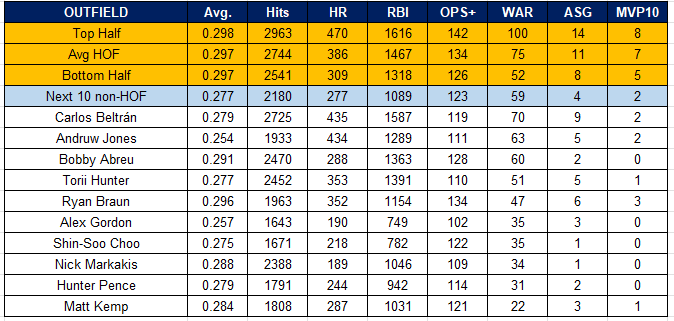
I admit that I’ve looked at Carlos Beltran from both sides now – in his first few years on the ballot I dismissed him as a cheat and lumped him in with the PED folks, and then last year had a change of heart and decided his transgressions were not worth denial of admission to Cooperstown. Well, I’m flipping again; I read over my arguments from last year and found them wanting. Frankly, I find it difficult to distinguish the Houston cheating scandal from PEDs. Both were conscious, illegal actions taken over an extended period of time that affected the outcomes of games, including World Series titles, and the stats that propelled those outcomes. The cheating was not a one-time bad decision, it was ongoing and extremely calculated and Beltran, a team-leader, was extremely guilty. I stipulate that his stats are HOF-worthy, and he may be a decent guy, but thumbs down to Beltran on baseball’s ultimate honor. Let him settle for not being banned from baseball or having the ‘Stros championship revoked or, for that matter, clawing back any of his salary.
Andruw Jones is an interesting case, with that very pedestrian .254 batting average and relatively low 111 OPS+. His candidacy hinges on those 434 homers and a very impressive 63 WAR that reflects his superlative defensive skills. He had a defensive WAR of 24, which is 22nd all-time and tops among outfielders by a wide margin. Jones reminds me of Brooks Robinson, who also was not a superlative hitter (Brooks’ OPS+ was 105 for his career – only 5% better than the American League average!). Both players have fine power stats, played superb defense and excelled in the postseason, playing for perennial contenders. For Jones, as for Brooksie before him, that all adds up to a well-earned thumbs up.
Torii Hunter, like Jones, has a “great fielder, solid hitter” profile, but the comparison for HOF purposes does not quite hold. Hunter was a slightly better hitter than Jones, on balance, but light years away from Jones defensively. He did win nine Gold Gloves, but unlike Jones, who won ten, modern defensive stats don’t back up Hunter’s reputation as they do for Jones. Hunter’s defensive WAR is a puny 4, compared with Jones’s 24. Hunter had several excellent defensive years in his 20’s, and the reputation he earned from those years clearly carried him into his 30’s, when he won a number of Gold Gloves without the stats to support them. And that ultimately shows up in his WAR, which, at 51, is well below Jones’ and that of the borderline groups. We give Hunter a thumbs down.
I spent much time last year comparing Bobby Abreu favorably (at least on offense) to Ichiro Suzuki, who missed becoming the first batter to be unanimously selected on the first ballot by a single vote. This chart might help make the case:
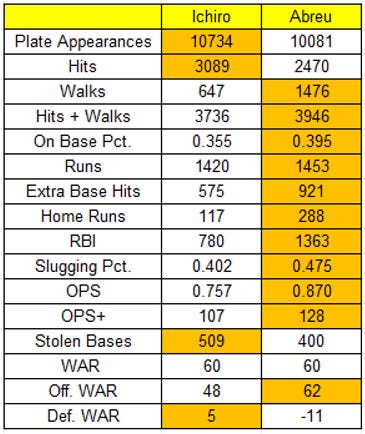
Ichiro and Abreu each had long careers, with over 10,000 plate appearances (Ichiro actually had about a season’s worth more plate appearances than Abreu). Abreu got on base more AND hit more for power. He had more runs AND more RBIs. Ichiro, essentially, was a single hitter and did not walk much. Abreu walked a ton and hit for power. It’s not even close: Abreu was the superior offensive player. Ichiro made up for that by stealing more bases (though not by as big a margin as you might have thought) and playing far better defense, and thus they ended up with identical 60 WARs. It seems inconceivable to me that Ichiro had 10 All Star selections and 4 Top 10 MVP vote years, while Abreu’s numbers were 2 and 0, respectively. But Ichiro was a cultural phenomenon and Abreu was vastly underrated. But if Ichiro is a Hall of Famer – and there is no doubt he should be – then how could Abreu not be one as well? Thumbs up for Bobb Abreu.
I only mention Ryan Braun here since I wanted to satisfy my own curiosity whether he would have made the Hall based on his stats. But his candidacy, at a glance, looks pretty borderline, so I’m not going to waste my time figuring it out since these are PED-inflated stats anyway, so why bother.
The rest of the candidates are reasonably similar. Alex Gordon, Shin-Soo Choo, Nick Markakis, Hunter Pence and Matt Kemp did not even make it to the Land of Very Fine Players (my name for those who had WARs in the 40-49 range), so what might I call them? Not only are their stats not in field goal range of the Hall of Famers or the Next 10, they are not even in the same stadium. I think it is just simpler to dispense with them all with a simple thumbs down.
Designated Hitter
Edwin Encarnacion played third based in his early years, and first base later on, but the plurality of his plate appearances came as a DH. So we put him there.

Encarnacion hit a ton of home runs, but apart from that his stats are not near the norm of DH Hall of Famers (Paul Molitor, David Ortiz and Edgar Martinez). They are far more aligned with the non-HOF DH’s (Julio Franco and Mo Vaughn). Plus he was a truly terrible fielder when he was out there, and that dragged down his WAR. I did not have to spend too much time to arrive at a thumbs down conclusion.
Starting Pitchers
We recognize that the sands are shifting for the criteria to evaluate starting pitches for the Hall of Fame. Long gone are the days of complete games and 20-game winners, and Justin Verlander may be the last pitcher to threaten to crack the 300-win club, and at this poiot he is a tremendous long shot with 266 wins at age 42 (he had only 4 wins in 2025). Indeed, Clayton Kershaw may be the last pitcher to make it to even 200 wins. Gerrit Cole is third on the wins list among active pitchers, after Verlander, Max Scherzer, now that Kershaw has retired. But Cole is now 35, and he tread water at 153 wins after missing all of 2025 due to injury.
So our comparisons will change in light of this, and we will deemphasize wins, won/loss percentage and innings pitched in our little chart, and put more focus on ERA+ and WAR, which are only modestly affected by the new requirements for starters (100 pitches, thank you, good for about six innings) as well as All Star Games, Cy Young Awards and postseason records. We might add WHIP in the future, and will reassess once we build up a database of “new era” starters.
This year Mark Buehrle and Felix Hernandez return to the ballot, and they are joined by Hamels and, inexplicably, two rather pedestrian starters, Gio Gonzalez and Rick Porcello.
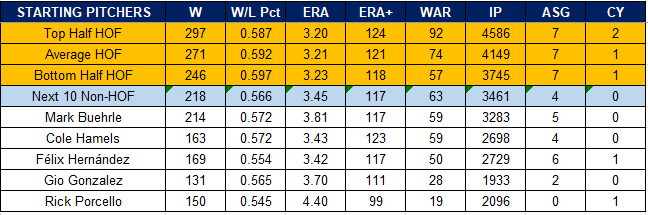
Mark Buehrle is certainly one of the better 21st century pitchers, a member of the 200-win club. He pitched from 2000-2015, thus might not be a bad person to start with that “new era” starter database. But he pitched 200+ innings for 14 straight years, and hurled 33 complete games, so things have changed even since he hung up his spikes. His stats are remarkably comparable to the “Next 10” group, which means he is a borderline candidate. (Once he leaves the ballot, he will become a member of that group if he has not made the Hall.) So, we have to say thumbs down to Buehrle, for now. But his candidacy will age well, and I suspect his stock will rise in his remaining years on the ballot, and with, if needed, some future Contemporary Era Committee.
Much of what I said about Buehrle goes for Cole Hamels as well. He was behind Buehrle by five years, pitching from 2006-2020. Hamels pitched ~600 fewer innings than Buehrle, had ~60 fewer wins and about half as many complete games (17) as Buehrle even while achieving a better ERA+ and equal WAR. Hamels had much more postseason experience and did fine (7-6 with a 3.41 ERA in 17 starts) if not exceptionally. All in all, it is not quite enough for me to make the leap into a new era standard, but again, his candidacy will likely age well – and for him, if not Buehrle, in the BBWAA time frame. But thumbs down for now.
Felix Hernandez pitched in the same time frame as Hamels (2006-2019) and the two have eerily similar statistics. King Felix has an appreciably lower WAR than Hamels, but he has both a Cy Young and a perfect game to his credit, unlike Hamels. We can simply stop there and declare that the same things we said about Buehrle and Hamels apply to King Felix as well. Including the thumbs down.
Gio Gonzalez is definitely not in the same class as Buehrle, Hamels and Hernandez, and Rick Porcello is not even in Gio Gonzalez’s class. Porcello did pull the neat trick of winning a Cy Young Award (in 2016) but failing to ever make an All Star team (2016 inclusive). It’s an easy thumbs down for both, and you have to wonder why Porcello was even on the ballot, since his ERA was below the league average for his career.
Relief Pitchers
Francisco Rodriguez returns to the ballot as the only reliever.
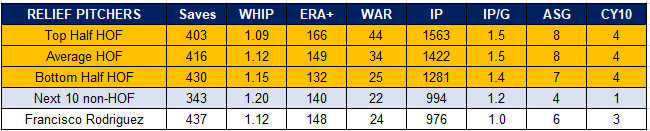
As you might expect, we use different statistical categories to evaluate relief pitchers. Saves, of course, is a primary consideration, and we use WHIP as a measure of dominance that varies nicely and in expected ways among our categories. ERA+ and WAR both work for relievers, and we also use innings pitched and innings pitched per game to highlight how the closer job has evolved to strictly a one-inning gig.
Francisco Rodriguez fits nicely with the averages of all the relievers in the Hall of Fame (we exclude Dennis Eckersley from the stats due to his long career as a starter). His WAR is a little low, but in line with the lower half of the group. Without too much effort, I give K. Rod a thumbs up.
‘*****************************************************************************
Again, the honorees will be announced on January 20, 2026. If there are no honorees, they will announce that, too.
Stay tuned.