
BTRTN: Three Months Until the Midterms – Can the Democrats Flip Both Houses of Congress?
The latest in Tom’s series of articles on the midterms.

ELECTORAL ENVIRONMENT
In the six weeks since our last update, the political environment has trended modestly downward for the Republicans, as the term “endless” became the modifier of choice for the Iran War and the price of gas surged once again (back over $4 on average nationally). Of course, six weeks ago we termed the political environment for the GOP “borderline disastrous,” so with the dip perhaps the GOP is now firmly in “disastrous” territory.
Nothing Trump has done in the second year of his second term has followed remotely the conventional playbook for a president on the cusp of an adverse midterm verdict. They typically seek ways, reflexively and rather desperately, to avoid a potential bloodbath. But Trump seems to be actively asking for a shellacking – seemingly simply uninterested in the midterms, with his flailing America-last war and tariff policies, outright indifference (by his own words) to the economic concerns of the electorate, rejection of GOP-supported housing relief legislation in deference to the unpassable SAVE America Act, and an obsession with building projects, especially the Washington Monument Reflecting Pool.
By the numbers: Trump’s approval rating dropped two points last week, plummeting to 37% for the first time in The New York Times’s polling aggregation (now at 38% with 59% disapproval). Trump began his second term with a 52% approval rating, but it has declined more or less continuously since. The latest drop came after yet another round of “we’ll bomb them to hell” and “we have a tentative deal” posturing, neither of which occurred. Americans are getting used to the whiplash and are increasingly unhappy with it – even MAGA (according to a recent CNN poll, 45% of Republicans say the war’s toll is “not worth it”).
Trump remains underwater on every single issue (per Real Clear Politics, a GOP-friendly aggregator): on the economy (-25 net approval), inflation (-39!), foreign policy (-19), the Iran War (-25) and even immigration (-9) and crime (-6). That means there is literally no safe topic for Trump to talk about, putting not only him and his surrogates on constant defense, but also every single downballot GOP candidate in a swing election, who are pining for something -- anything -- from Trump that addresses the economy.
The primary season has continued, but the last six weeks’ election news has been more notable for two other consequential shocks, the abrupt departure of Graham Platner from the Maine Senate race and the death of South Carolina Senator Lindsay Graham. Maine, of course, is a wildly significant state for the Senate midterms, as a legitimate flip opportunity for the Democrats, and while South Carolina is not truly in play, Graham was not as solid in the Gamecock State as one might think and his TBD successor on the ballot is not a given to romp in November. The most significant primary was Michigan’s, although the general election significance of progressive Abdul El-Sayed’s win has been feverishly overstated, at least according to the polls.
Finally, Democrats continue to dominate special elections; according to Downballot, there have been 118 special elections in the past 20 months, largely local elections to replace members of state legislatures who have resigned or died. In those 118 districts across the country, the Democrats on the ballot have outperformed Kamala Harris’s 2024 performance in those same districts by +13 percentage points on average. That +13 points swing (please remember that number as you read through the rest of this) is a pretty good proxy for how far blue the electorate has shifted during (and because of) Donald Trump’s second term. That means, in a nutshell, that every Republican who won an election by +15 points or less in 2024 is vulnerable in 2026, and those who won by less than +10 probably enter their reelection campaigns as underdogs.
Our latest odds, and how they have changed since late June, are as follows:
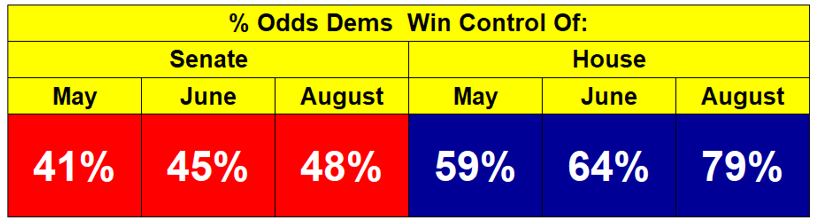
Remember, this is a snapshot, not a prediction. With about three months to go before Election Day, things can change. But if the election were held today, or if race dynamics do not change materially by Election Day, this would be our prediction.
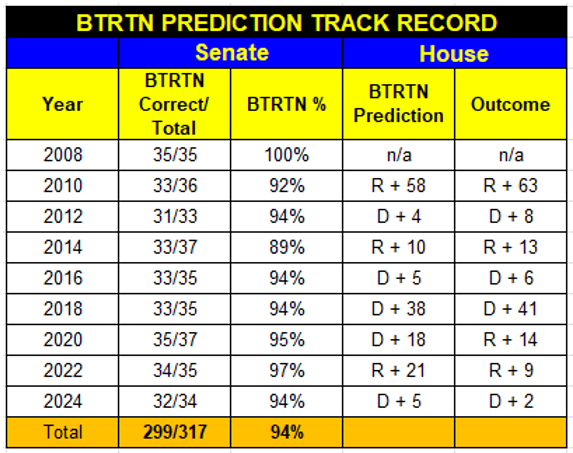
See the chart at the bottom of the page for how we at BTRTN have done in our predictions in past cycles (since 2008 for the Senate, 2010 for the House).
On to the House and Senate updates.
THE HOUSE
The Republicans hold a narrow 220-215 margin in the current House, meaning that the Democrats need only win a net of three seats to regain control of the body. That seems to be a near given at this point.
As we have noted before, the most important variable in assessing potential gains and losses by the respective parties in the House midterms is the generic ballot, a polling question in which voters are asked whether they would vote for a Democratic or Republican representative if the election were held today, without naming names. In the last six weeks, the Democrats lead in the generic ballot has risen from +5.4 percentage points to +6.6, a sizable jump. This, of course, directly reflects the deteriorating political environment for the GOP, and is consistent with other data, including Trump’s declining approval rating.
Our BTRTN House model, which consists of the generic ballot (the most powerful variable) plus other fixed variables (the current make-up of the House; the party in control of the White House and the House; the term of the president) suggests that a +6.6-point lead in the generic ballot would translate to a pickup of +31 seats for the Democrats. That’s not quite of “wave” magnitude, as the opportunity for flips is dampened by the fact that the Democrats already hold 215 seats, and there are fewer seats in play in general (only about 77 by our count, and less than half that number if you don’t count the races rated “likely”).
But we have to adjust that number downward for two very good reasons:
· First for redistricting net losses, which the model could not anticipate or incorporate. The Republicans did well in the now-completed redistricting wars of 2025/26, but not nearly by enough to overcome the disastrous environment in which they are competing. The best estimate of outright GOP flips resulting from the new maps is +8 seats.
· In the past several election cycles’ polling, there has been a persistent underweighting of GOP votes on the final generic ballot compared to the national House vote, on average by about two points, which would translate to 8 seats in the model.
When you put the math together (31-8-8) you come out to a Democratic gain of +15 seats, more than enough to flip the House. This would take them from 215 current seats to 230, holding a commanding 230-205 margin in the House when all is said and done.
That’s a little too precise for my comfort. The most likely range of outcomes is +10 to +20 seats gained by the Democrats. Perhaps most importantly, our model suggests that this translates to a 79% chance of the Democrats taking the House – excellent odds and significantly higher than before (64%).
THE SENATE
The Democrats currently hold 47 seats and thus need a net of +4 to gain control of the Senate with 51 (given the GOP-controlled White House and thus J.D. Vance holding the tie-breaking vote in the Senate). A year ago, the 2026 map looked brutal for them, with only two plausible flip opportunities, in Maine (which Harris won) and North Carolina (which is always razor thin). But with Trump’s steady decline and a slew of remarkably favorable matchups, the map has been expanded to seven GOP seats reasonably in play.
There is a political maxim you are hearing this year that all paths to Senate-control by the Democrats go through Maine. In other words, if the Democrats lose Maine, they cannot flip the Senate. I am not at all certain of that. While the national environment has tended to turn House races into national races, the individual candidates – and thus the match-ups – play a stronger role in Senate races. And Susan Collins is perhaps the strongest GOP candidate among the contested races, while Troy Jackson could very well be the weakest, given the circumstances of his anointment. Therefore, I can envision, without much effort, scenarios in which the Democrats lose Maine but still manage to dlip four other GOP-held seats. Not easy, but plausible.
I will say that the road to Democratic control of the Senate does go through Michigan. The price of admission for the Dems to entertain control thoughts is to successfully defend all of their current seats, and Michigan is easily the riskiest as we sit today.
Control of the Senate will likely, as we see it now, will come down to the fate of these 11 Senate races.
· Four seats the Democrats are defending (Georgia, Michigan, Minnesota and New Hampshire). It’s safe to say the Democrats should pick up both Georgia and Minnesota quite handily. In both states the Democratic candidate leads their GOP rival by nearly double digits. Jon Ossoff in Georgia is doing so well that the whisper campaign to tout his 2028 presidential candidacy chops has swelled to a near roar. We still await the Minnesota primary (on August 11) but both candidates, mainstreamer Angie Craig and progressive Peggy Flanagan, are faring well in polling against the likely GOP nominee, former NFL sideline reporter Michele Tafoya. We have both races as Likely Democratic.
Polling has been light in New Hampshire, but in the only semi-recent poll, U.S. Democratic Rep Chris Pappas (who will be nominated in the September primary) is ahead of former Senator John Sununu (the future GOP nominee) by +6 points. This one does not have the feel of a nailbiter, but we have in the Lean Democratic column pending further polling.
Michigan is another story, one of the few battleground races where the Democrats do not have a favorable match-up. Al-Sayed is a progressive in a purple state, and while the progressive wing in the party is thrilled with a win outside of Kamala Harris-dominated venues, it leaves them at least a tad more vulnerable. The GOP is running (again) a very solid candidate, the mainstream (for his time) U.S. Rep Mike Rogers. The polls pitting Rogers against El-Sayed are slightly in Rogers’ favor. (FYI, the numbers show that mainstreamer Haley Stevens would fare, at best, only slightly better than Al-Sayed against Rogers, but even that statement is a bit suspect given the nature of primary polling.) Our view with such limited polling is that our ratings favor the incumbent party, so we are calling this one Toss Up Democratic pending more information.
· Two traditionally competitive seats held by Republicans (Maine and North Carolina). North Carolina has emerged as (easily) the most flippable GOP seat, as popular terming-out Democratic Governor Roy Cooper is solidly ahead (roughly +9 points) of GOP nominee Michael Whatley, the former RNC chair. Clearly a Likely Democratic at this point.
As for Maine, go figure. This is a brutal state to predict: in 2020, Collins trailed Democratic challenger Sarah Gideon by -5 points in the polls but won by +9 points…in a state that Joe Biden won by +10 points! Democratic primary winner Graham Platner finally crossed the one-too-many-revelations red line (with sexual assault accusations) and was forced to stand down, leading to the emergence of veteran Maine politico Troy Jackson to pick up Platner’s progressive mantel and make a go of it. He’s ahead of Collins in the polls by a few points, and that and $1,000 will get you ownership of the Piscataqua River Bridge. This is a true toss-up, to say the least, and sticking with our rule, we have this as Toss Up Republican pending more information.
· Five GOP seats now in play. Even if the Democrats manage to defend successfully their four seats and flip the two traditionally competitive seats, they still need two more to get to 51 and Senate control (or three more if they lose Maine). Those pickups will have to come from among five red states that Trump won by double digits in 2024. But remember the special election results, in which Democrats are outperforming 2024 by +13 points. As of now, the polls in these states all conform that theory – in these states the Democrats are all doing even or better in recent polling.
Ohio. This is as good as match-up as the Democrats could hope for, with former Democratic Senator Sherrod Brown challenging incumbent GOP John Husted, who was appointed – not elected – to fill J.D. Vance’s seat in 2025. Trump won the state by +11 in 2024, but Brown is ahead in the polling by +3 on average. Another Toss Up Republican, and more of that to come.
Alaska. Alaska is as quirky as Maine, so this will be another tough one to predict. The Democrats have another proven winner, Mary Peltola, atop the ballot; she won the race to become Alaska’s sole House rep in 2022, but narrowly lost reelection in 2024. She is challenging incumbent GOP Senator Dan Sullivan in a state Trump won by +13, and, in the single poll we have seen in this race – from March! -- she leads by +6. But one poll from months ago is not enough to persuade us to change our rating as yet, which is Toss Up Republican.
Iowa. Another red state in which the Democrats got the most favorable match-up they could have asked for, having nominated the more mainstream candidate, Josh Turek, a former Paralympian. He’ll oppose the Trump-backed, MAGA-based Ashley Hinson, in another state Trump won by +13 in 2024 – and again, sparse polling to date has Turek up by +1 points. Toss Up Republican.
Texas. The GOP primary win by controversy-laced Ken Paxton was an avoidable GOP hot mess that renders the seat vulnerable. Paxton’s sordid past includes fraud accusations and marital infidelity, but Trump’s endorsement good enough for Texas Republican voters to overlook all that. But it’s hardly a good look in a race against telegenic wunderkind (and divinity student) James Talarico in another best-the-Dems-could-have-hoped-for matchup. The same pattern has emerged in Texas: Trump won the state by +14 in 2024, but Talarico is a tad ahead (+3) in the polling. Toss up Republican, though, given Texas’s red history and awaiting more polling.
Nebraska. And control of the Senate could all come down to a single guy in Nebraska who is a member of neither major party. The Democrats are not running a candidate in this state that Trump won by +20; instead, they are banking on independent Dan Osborn. Osborn lost to GOP Senator Deb Fischer by only -6 points in 2024 and will now challenge former Governor and incumbent Senator Pete Ricketts this November. Ricketts was appointed to replace Ben Sasse when Sasse resigned in 2023. While early polling favors Osborn, he has not declared which party he would caucus with if he won, if either – which puts him in a quite a position if all the chips fall a certain way. Likely Republican, for now.
More races could come into play, and some of these could drop off, as we head down the stretch. But as of now, here is a summary, in chart form, of the 11 Senate races that will decide control of the Senate in the midterms, including our BTRTN race ratings. You can see how favorable (though, in general, scant) polling is for the Democrats. Four of them (with asterisks) have moved more in the Democrats’ direction – Georgia, Iowa, North Carolina and Texas. Look at all those toss-ups!
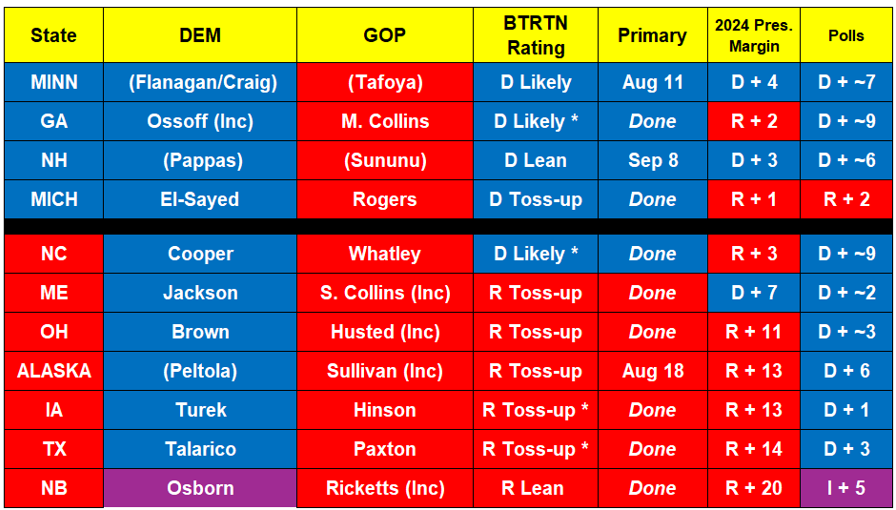
The by and large favorable match-up movements and early polling results for the Democrats have resulted in an increase in our BTRTN odds, from 45% in late June to 48% now. It’s hard to get over that 50% mark given the current state of Maine, Michigan and those four Trump +10 or more red state, but the Democrats are making it close indeed.
As said, much can happen in the next three months in what has been the most jolting presidency of them all. Having said that, there are no clear catalysts on the horizon that seem likely to materially change the election environment. Trump will focus on process rather than message, trying to dampen Democratic votes in any way possible. But try as he might to shove a stick into the election process wheel, that stick may not nearly be big enough to slow down Democratic voting motivation and momentum.
Stay tuned.
*The chart below details our BTRTN track record in predicting Senate and House elections over the last 17 years.
Tom, thanks for the article. Things seem to be moving int he right direction. Like a lot of people now I am curious about the Michigan Senatorial race. It seems as if the R candidate's reputation as a "tough opponent" rests primarily on his close loss to Slotkin in the 2024 election. Given that Trump was on the top of the ticket that year which seems to help Rs by bringing out the base, will his absence from the ballot - and his current unpopularity- reduce that tailwind for Rogers and make him less "tough" to beat. I.e. is his strength being overestimated by commentators? BTW, how many polls have been conducted since El-Sayed won the primary?
CD
Your usual astute analysis, Tom. Many thanks!
I’m writing from Florida, and the state GOP has, of course, gerrymandered the House districts to produce more Republican House winners. Here is what I am curious about: have they bled enough GOP voters out of safe Republican districts to open some of those districts to possible Democratic winners? They have cut some of the formerly double digit GOP margins down to single digits in areas like the Tampa Bay region, House District 16, e.g., where the Democrats have a very attractive candidate in Kelly Kirschner, the former mayor of Sarasota. I’m wondering if DeSantis & Co. just might have outfoxed themselves.